

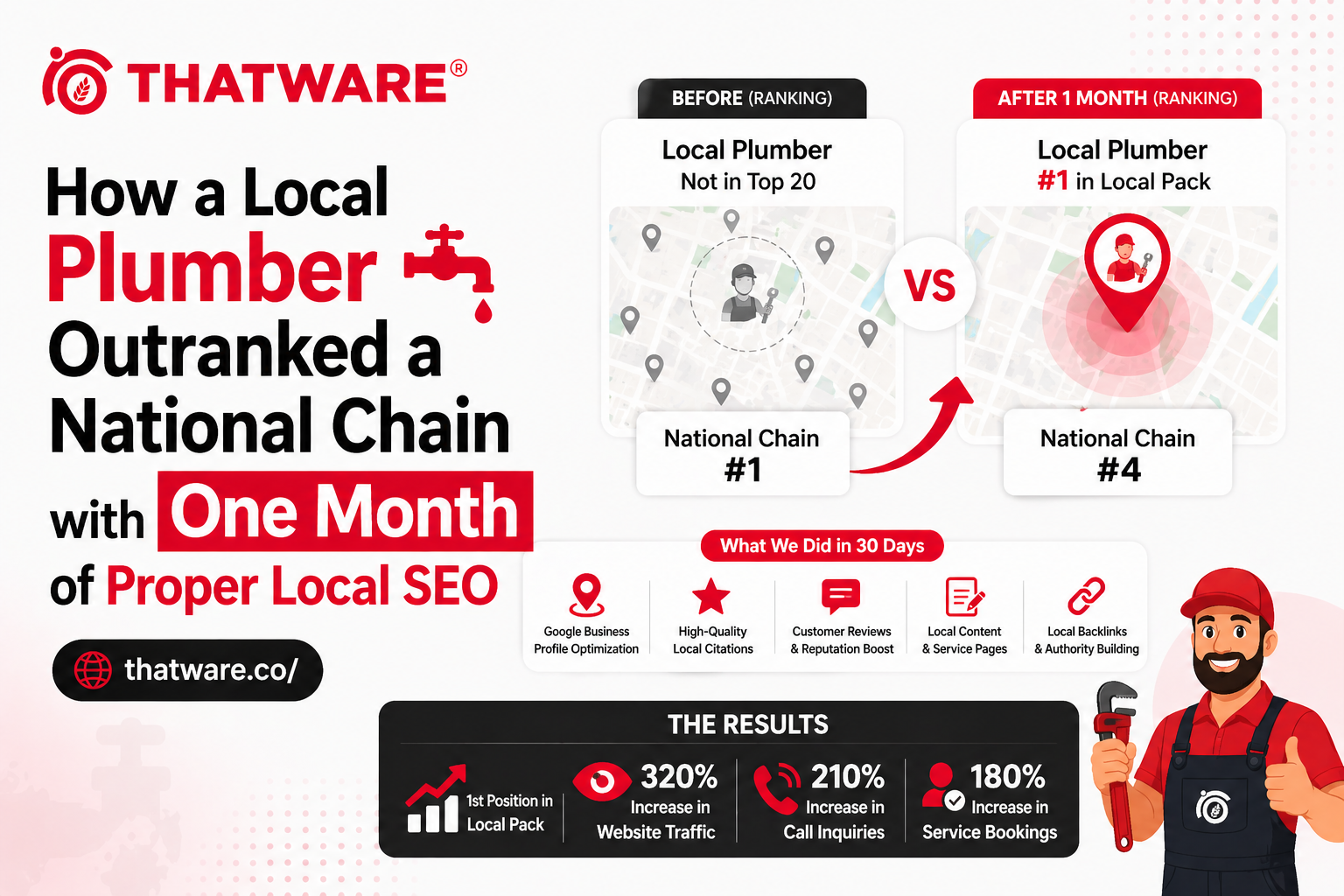
This is a real story, though the names are changed. And it’s worth telling in some detail because it illustrates, more concretely than any framework could, exactly what “proper local SEO” means in practice versus what most businesses are actually doing.
The plumber in question had been in business for eleven years. Solid reputation. Reasonable volume of Google reviews — maybe 30, all positive. A website that worked on mobile, had his phone number on it, and listed his services. By most definitions, he was “doing SEO.” He had a Google Business Profile. He showed up in local results — just not the ones that mattered. For “emergency plumber [city]” and “plumber near me” — the queries with real commercial intent — he wasn’t appearing in the Map Pack at all. A national franchise with a branch in his city was sitting in the top three consistently, along with two other local competitors.
One month of focused local SEO work later, he was in the Map Pack for his primary city queries and several surrounding suburb searches. Here’s exactly what was done.
Week One: The Foundation Audit
The first week was almost entirely diagnostic. No changes yet — just a thorough audit of where things actually stood.
Google Business Profile review: his profile was claimed but significantly incomplete. The business description was thin and generic. Service categories were partially correct but missing several relevant ones. Business hours weren’t set for holidays. The Q&A section had unanswered questions from potential customers. Photo count was low — just a handful of exterior shots and a logo. No service-specific photos, no team photos, no “before and after” work examples.
Citation audit: his business name, address, and phone number were listed inconsistently across directories. Yelp had an old address from before he moved locations three years prior. Three different phone numbers appeared across various directory listings — two old numbers that had been forwarded but still confused aggregation systems. His business name appeared as “Steve’s Plumbing,” “Steve’s Plumbing Services,” “Stevens Plumbing” and two other variations across different sources.
Review analysis: 30 reviews, all positive, but the most recent was eight months old. No response to any reviews, positive or negative. None of the reviews mentioned specific service types, locations, or outcomes — they were all generic “great service” type feedback.
Competitor analysis: the Map Pack winners had several things in common. More reviews, all recent. Consistent NAP across directories. Active GBP with recent photos and posts. Several had specific service-area pages on their websites.
Week Two: Foundation Fixes
Local seo agency work properly done treats foundation issues as the priority before any growth-oriented work. That’s what week two was.
GBP optimization: the description was rewritten to be specific, service-rich, and locally anchored — mentioning the city, the types of plumbing work covered, and a concise version of the brand’s differentiators (emergency availability, licensed and insured, local for 11 years). All relevant service categories were added. Holiday hours were set. Existing unanswered Q&A questions were responded to. Fifteen new photos were added over the course of the week: team photos, vehicle photos, three “before and after” job photos, and service-specific images.
Citation cleanup: the incorrect Yelp address was corrected. Old phone numbers were updated across every major directory — Google, Apple Maps, Bing Places, Yelp, Yellow Pages, BBB, and a dozen others. Business name was standardized to “Steve’s Plumbing” consistently across all sources.
Website: two simple service-area pages were added — one for the primary city and one for a high-volume suburb — each with locally-specific content addressing the most common plumbing needs in that area and genuine local mentions (neighborhoods, local landmarks as context for service radius).
Week Three: Reviews and Authority Signals
Week three focused on review generation and local authority.
A simple post-job text message workflow was set up — three days after job completion, a brief thank-you message with a direct link to leave a Google review. The message was written to feel personal, not automated. “Hope the [specific job type] is working well — if you have a moment, a Google review really helps a small business. Here’s the link.”
In the first week of this system running, seven reviews came in. Crucially, because customers were texted shortly after their jobs, the reviews were specific: “Fixed our burst pipe in under two hours,” “Emergency call on Sunday, arrived within 45 minutes,” “Kitchen drain clearance, excellent work.” These review texts were doing keyword work — mentioning service types and response times — that generic reviews don’t do.
Every review — new and old — was responded to. The responses were personal, named the job type, thanked the customer specifically, and in several cases mentioned the neighborhood or area.
Local authority building: the plumber was added to three local community directories that had been missed in the citation audit. A brief mention in a local neighborhood Facebook group (authentic, not promotional — he answered a plumbing question someone asked) generated a comment that led to a job and a new review.
Week Four: Refinement and Monitoring
By week four, early movement was visible. The GBP was showing increased views and calls from profile. Ranking monitoring showed movement for several target queries — not yet Map Pack for the primary city query, but appearing in extended local results.
The final week of the month involved: a Google Post published (a seasonal maintenance tip, genuinely useful content that also signaled profile activity), a structured data review of the website to ensure LocalBusiness schema was correctly implemented, and setup of monthly monitoring — rank tracking for priority local queries, review count monitoring, GBP insights review.
Local seo services that work are almost always this unglamorous. There’s no secret technique. There’s just thorough execution of the things that are known to work: entity clarity, review recency and specificity, NAP consistency, profile completeness, and the local content signals that tell Google this is a genuinely locally-oriented business serving a specific geographic area.
What Came After
By the end of month two, Map Pack visibility for primary city queries was consistent. By month three, several nearby suburb queries were converting Map Pack appearances to calls. By month four, the plumber had surpassed the national franchise for most of his primary city queries.
The national franchise didn’t have bad local SEO — it was adequate. It just hadn’t been treated as a priority because it’s one of dozens of locations. The local plumber, with focused attention, went from “adequate” to “genuinely optimized” in one month and then into the position of genuine local authority with a few more months of consistent review generation and profile maintenance.
The lesson isn’t that local SEO is easy. It’s that most of the competition isn’t doing it properly. And in local search, that gap is very much worth closing.